
March 28, 2016
Dr. Jeremy Boak, Director Oklahoma Geological Survey Statement on USGS Hazard Assessment for Sites with Induced Seismicity
A copy of the statement can be found here.
March 28, 2016
Governor Mary Fallin Says USGS Earthquake Hazard Map Shows State Regulators Are Taking Correct Action
OKLAHOMA CITY — Governor Mary Fallin today said the first-ever map developed by the United States Geological Survey (USGS) showing potential ground-shaking hazards from both human-induced and natural earthquakes illustrates why action taken earlier this year by the Oklahoma Corporation Commission (OCC) was necessary.
Researchers say the state’s rise in earthquakes is caused by the disposal of produced saltwater deep into the Arbuckle formation. The OCC, which has constitutional authority over oil and natural gas activity in the state, is following the recommendation of researchers and is continuing to work with operators to significantly reduce the overall disposal of produced water into the area of seismic interest within the Arbuckle formation area to 40 percent below the 2014 total.
The OCC last month issued a wide-ranging directive to saltwater disposal well operators in areas experiencing earthquakes. In the past year, regulators have issued more than a dozen directives to disposal well operators to limit activity or shut down in areas of earthquakes.
“Recent declines in produced wastewater disposal in Oklahoma are not reflected in the USGS map,” Fallin said. “This gives us even a stronger base in going forward and gives state regulators further justification for what they are doing.”
Today’s USGS report, which used earthquake data from 2015, states that some places in Oklahoma may experience damage if the induced seismicity continues unabated.
“Oklahoma remains committed to doing whatever is necessary to reduce seismicity in the state. The report supports the actions that we are taking,” said Fallin, who in 2014 formed the Coordinating Council on Seismic Activity, which organizes state resources and related activities to address Oklahoma’s earthquakes.
She said the USGS report will be reviewed to evaluate how recommendations can be included into the state Emergency Operations Plan and ongoing preparation efforts.
The governor, during a meeting with her Cabinet secretaries earlier this month, discussed how the state would respond to a large-scale seismic event. Fallin asked Department of Emergency Management Director Albert Ashwood to lead a statewide working group to develop an earthquake response plan.
Ashwood and several agency directors held their first meeting this morning.
“In Oklahoma, we recognize the importance of being prepared for all types of disasters that could affect the state, including earthquakes,” Ashwood said. “The Oklahoma Department of Emergency Management is reviewing the report released today by the United States Geological Survey to determine how it may aid our catastrophic earthquake planning efforts. However, it is important to note that for emergency management, the cause of a disaster is not as critical as the outcome of the event and how it impacts our residents, infrastructure and communities. Preparing for, responding to, recovering from and mitigating against those outcomes will continue to be our focus.”
Oklahoma Energy and Environment Secretary Michael Teague said the USGS report released today highlights why action has been taken to address induced seismic risk in the state of Oklahoma.
“The Oklahoma Corporation Commission’s work to further reduce the overall disposal of produced water into the Arbuckle Formation is in line with researchers from across the country as the best way to lower the potential for seismic hazard highlighted in the USGS report,” he said.
For more information on earthquake preparedness, visit http://eq.jonholzer.com/earthquake-preparedness
A copy of the press release can be found here.
###
March 7, 2016
Today, the Oklahoma Corporation Commission’s Oil and Gas Conservation Division issued a media advisory announcing a regional earthquake response plan for
Central Oklahoma and expansion of the area of interest.
The OCC media advisory detailing the new plan can be found here.
February 16, 2016
Today, the Oklahoma Corporation Commission’s Oil and Gas Conservation Division issued a media advisory announcing the implementation of the largest volume reduction plan yet for oil and gas disposal wells in western Oklahoma. The plan covers 5,281 square miles and 245 disposal wells injecting wastewater into the Arbuckle formation.
The OCC media advisory detailing the new plan can be found here.
February 16, 2016
OERB Research Grant to Modernize Wastewater Reporting System
Funding will be used to purchase new system to better collect, analyze data.
OKLAHOMA CITY – Governor Mary Fallin’s Coordinating Council on Seismic Activity today announced a research grant from the Oklahoma Energy Resources Board (OERB) that will create a new digital system to collect data on wastewater disposal wells in the state.
OERB, which is a member of the coordinating council, stepped up to help provide much-need technology improvements at the Oklahoma Corporation Commission.
“This is why I created the council,” said Fallin. “It proves that we have assembled the right group of industry representatives, agencies, regulators and researchers to address Oklahoma’s rise in earthquakes.”
Oklahoma Secretary of Energy and Environment Michael Teague, who heads the council, said the OERB grant will establish a standard format for disposal well operators to submit data to the Corporation Commission, while assisting the agency in collecting and analyzing disposal well data.
The project is part of an ongoing collaborative effort by Oklahoma’s oil and natural gas producers, the Oklahoma Geological Survey and the Ground Water Protection Council (GWPC).
“Through the OERB grant, the oil and natural gas industry is providing the critical funds necessary to revolutionize the way we collect and analyze data,” said Teague.
The OERB grant, which was approved Feb. 9 by the group’s board of directors, will be used to begin the first phase of the modernization project immediately.
The second phase, funded by GWPC with a grant from the U.S. Department of Energy, will expand the online system to provide detailed, real-time information to researchers across the country.
GWPC Executive Director Mike Paque said the new system will provide Oklahoma regulators and earthquake researchers with a more extensive and efficient handling of data on disposal well operations in the state.
GWPC, a non-governmental entity based in Oklahoma City, will take the lead in developing the new system.
“This project is the first of its kind and other states are watching Oklahoma closely, with great interest,” said Paque. “It will provide an unparalleled level of information.”
For more information, visit www.eq.jonholzer.com.
A copy of the press release can be found here.
January 28, 2016
Governor Mary Fallin Approves Transfer of Emergency Funds to Aid Oklahoma’s Earthquake Response
OKLAHOMA CITY — Governor Mary Fallin announced today she has approved the use of nearly $1.4 million from the state emergency fund to bolster the efforts of earthquake regulators and researchers in Oklahoma.
The funds will be directed to the Oklahoma Corporation Commission (OCC) and the Oklahoma Geological Survey (OGS).
Fallin recently asked the OCC and the Coordinating Council on Seismic Activity to determine what state agencies needed to better understand the earthquakes impacting parts of the state. She was presented with a list of needs totaling $1.387 million in one-time costs.
“I immediately made arrangements for the Corporation Commission and OGS to receive the money necessary to meet those needs,” Fallin said. “I’m committed to funding seismic research, bringing on line advanced technology and more staff to fully support our regulators at they take meaningful action on earthquakes.”
The emergency funds allocated by the governor will allow the OCC to proceed with much-needed computer updates and hire two contract geologists and other staff to work on seismic issues.
OCC Vice Chair Dana Murphy said the transfer addresses the need for essential resources.
“Efficient and timely handling of the huge amount of data involved is critical if we are to respond effectively to the earthquakes,” Murphy said. “The governor’s prompt action on our request addresses those concerns.”
OGS will use its share of the emergency funds to install additional seismic monitoring stations in western Oklahoma, update its monitoring network and upgrade its mapping systems.
The research agency also will conduct studies to shed light on how wastewater interacts with the Arbuckle formation, where most disposal wells operate, and the basement layer of rock below it.
OGS Director Jeremy Boak said the additional funding will meet a variety of the agency’s needs related to the increase of earthquakes in Oklahoma.
“The funds will enable us to provide better recommendations for remedial action to further reduce the rate and magnitude of induced earthquakes,” said Boak.
Breakdown of funding for earthquake research
Governor Mary Fallin has transferred $1.387 million from the state’s emergency fund to aid regulators and researchers working to understand Oklahoma’s increase in earthquakes.
The Oklahoma Corporation Commission will receive $387,000 for:
- Information technology upgrades
- Two contract geologists, contract clerical worker and geophysicist consultant
- Senior-level oil and gas attorney
The Oklahoma Geological Survey will receive $1 million for:
- Installation of additional permanent seismic monitoring stations
- Update seismic monitoring network and software
- Analyze the response of seismicity to regulatory and market forces driving changes in produced water injection
- Characterize the properties of the Arbuckle formation and basement rock in a complex fluid reservoir
- Workshops to share research results and define needs for additional studies
For additional information about how the emergency funds will be spent, visit http://eq.jonholzer.com/what-we-are-doing
January 28, 2016
Governor Mary Fallin Op-Ed
Science Must Guide Oklahoma’s Response to Increase in Earthquakes
Like many other Oklahoma residents, I have felt my walls shake from earthquakes that have struck our state with increasing frequency over the past few years. I take the concerns seriously and I share your worries about potential damage from the quakes, which numbered more than 900 with a magnitude 3.0 or greater last year.
But there is not an easy solution to halting Oklahoma’s unprecedented rise in seismic activity.
Researchers tell us the state’s rise in earthquakes is caused by the disposal of produced saltwater deep into the Arbuckle formation beneath north central Oklahoma, not by hydraulic fracturing, but haven’t provided any clear answers on how to stop the shaking.
Just as science has identified the cause of Oklahoma’s increase in earthquakes, state officials must rely on science as they work to reduce and halt them.
That is why I formed the Coordinating Council on Seismic Activity in September 2014. The council, headed by Secretary of Energy and Environment Michael Teague, has fostered communication among regulators, independent researchers, academics, policy makers and industry officials to drive the state’s response to its rise in earthquakes.
The Oklahoma Corporation Commission, which has constitutional authority over oil and natural gas activity in the state, has issued 14 directives in the past year to companies that operate Arbuckle formation disposal wells in areas where earthquakes have occurred.
Those directives were aimed at about 600 disposal wells in areas shaken the most by earthquakes. Ninety of those are not operating, while another 245 wells had their overall volume of wastewater disposal reduced by more than 450,000 barrels a day. That is nearly a 40 percent reduction in those areas.
Last week, regulators and Oklahoma Geological Survey researchers said they needed more money to better analyze, gather specific data and understand the science of induced seismicity and act on those findings. I immediately made arrangements for them to receive almost $1.4 million from the emergency fund to meet those needs.
The Ground Water Protection Council, a non-governmental entity based in Oklahoma City, also has secured funding from the U.S. Department of Energy to build an electronic database to track disposal well activity. It will be available to regulators and researchers from all across the country who are studying Oklahoma earthquakes, so we can make informed decisions to help reduce seismic activity.
Those expenditures are necessary, given the threat increasing seismic activity poses to Oklahoma residents, their property, state infrastructure and the state’s economy.
I’m committed to funding seismic research, bringing on line advanced technology and more staff to fully support our regulators as they take meaningful action on earthquakes.
Our progress in this endeavor will be documented in a timely manner on the earthquake.ok.gov website. It is our central resource for Oklahomans interested in learning about what is being done to address seismicity. A complete list of the requested new projects can be found on the website.
In the meantime, the newly established Water for 2060 Produced Water Working Group will bring together experts to help us find better solutions for wastewater than pumping it back into the ground.
While there are certainly many issues for our state to address, earthquakes, like anything that impacts public safety, must always be near the top of our list.
Providing the tools requested by our scientists and regulators to do their jobs better in addressing increasing seismic activity is what the people of Oklahoma expect and something I fully support.
January 21, 2016
Today, the Oklahoma Corporation Commission’s Oil and Gas Conservation Division (OGCD) released a media advisory announcing that Sandridge Energy has agreed to a plan that will both reduce the volume of wastewater being injected in the Medford and Cherokee/Byron areas, and convert some wells from disposal to research operations.
The OCC media advisory can be found here.
January 13, 2016
Today, the Oklahoma Corporation Commission’s Oil and Gas Conservation Division implemented a plan in response to recent earthquakes in the Fairview area. The plan calls for changes to the operations of oil and gas wastewater disposal wells in the area that dispose into the Arbuckle formation.
The OCC advisory detailing the new plan can be found here.
January 7, 2016
This week, the Oklahoma Corporation Commission Oil and Gas Conservation Division implemented a plan in response to recent earthquakes in the Edmond area. The plan calls for changes to oil and gas wastewater disposal well operation in the area that dispose into the Arbuckle formation.
The OCC advisory detailing the new plan can be found here.
December 3, 2015
Today, the Oklahoma Corporation Commission’s Oil and Gas Conservation Division continued its evolving response to earthquake activity in the Medford and Cherokee areas. The latest step is implementation of plans for the Byron/Cherokee area and for the Medford area. As with previous steps, the plans call for changes to oil and gas wastewater disposal wells in the area that dispose into the Arbuckle formation.
The OCC’s advisory detailing the plans can be found here.
November 19, 2015
The Oklahoma Corporation Commission has recently taken specific actions on disposal wells in the Medford, Fairview and Cherokee-Carmen areas in response to seismic events.
Details for each action can be found at the following links to the OCC website:
- November 10, 2015 plan in response to Medford area seismicity.
- November 16, 2015 plan in response to Fairview area seismicity.
- November 19, 2015 plan in response to Cherokee-Carmen area seismicity
October 19, 2015
On Friday, October 16, 2015, the Oklahoma Corporation Commission’s Oil and Gas Conservation Division (OGCD) added additional oil and gas wastewater disposal wells to its action plan for the Cushing, Oklahoma area. The goal of the plan is to reduce the risk of induced earthquakes in Cushing area by changing the operations of the specified disposal wells. This latest action now calls for operational changes at a total of 13 disposal wells. Operators of 13 other disposal wells have been put on notice that changes may be needed in the future.
A copy of the letter to operators can be found here.
September 18, 2015
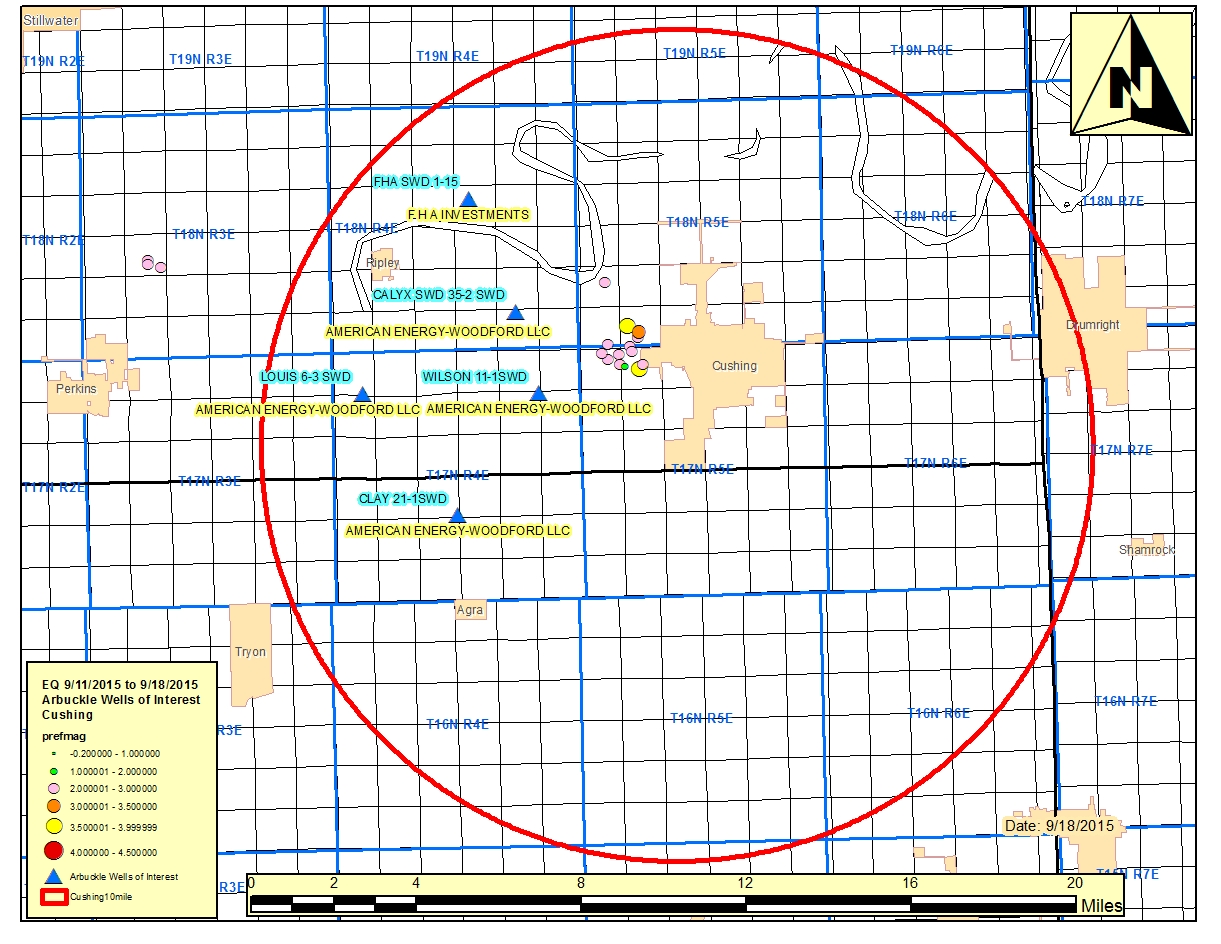
As a result of an analysis of disposal well and seismicity data in the Cushing area, the Oklahoma Corporation Commission’s Oil and Gas Conservation Division (OGCD) implemented a plan today to change the operation of certain oil and gas wastewater disposal wells.
The plan calls for 2 disposal wells to stop operations, and for 3 others to reduce the disposal volume.
Wells subject to the new plan are indicated in this map provided by the Corporation Commission:
August 4, 2015
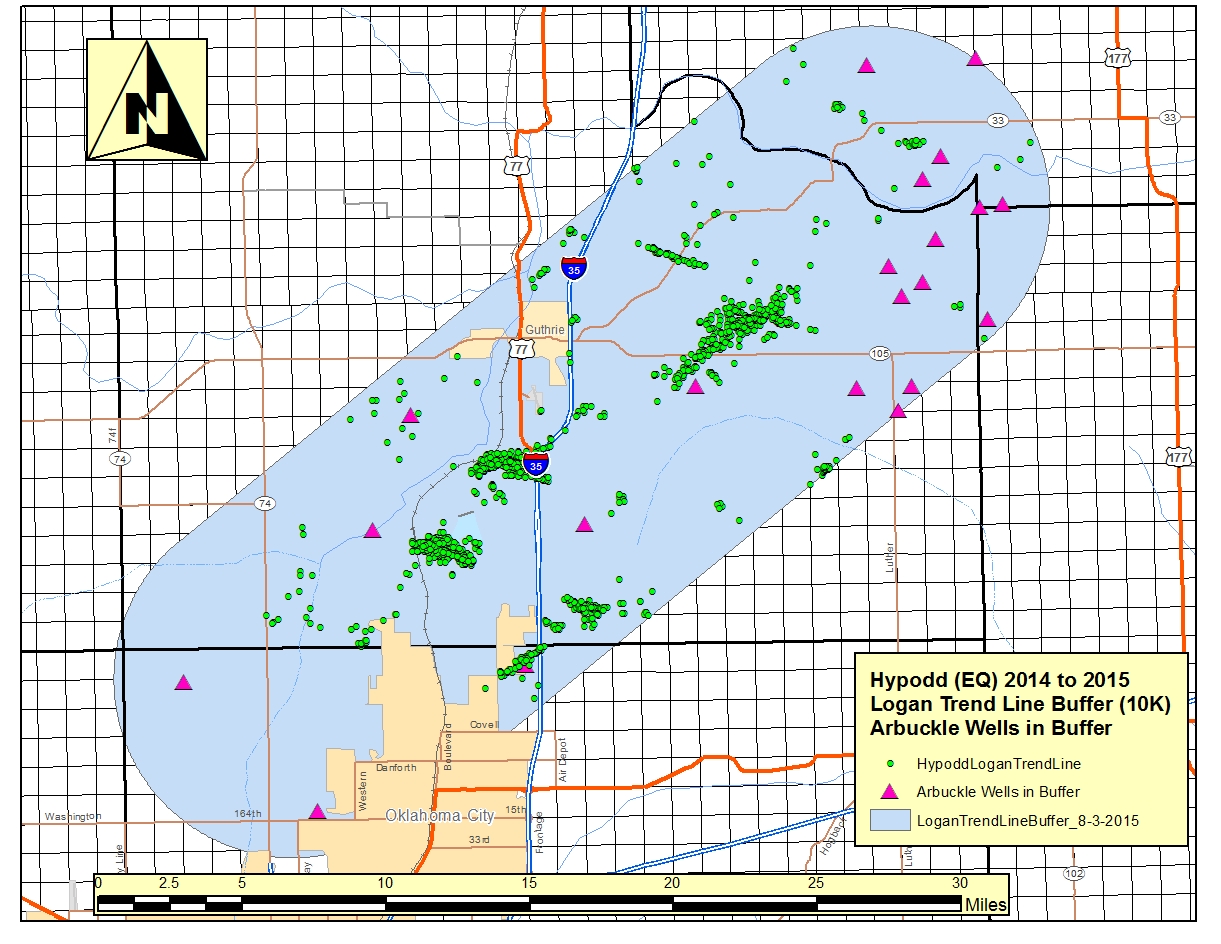
The Oklahoma Corporation Commission’s Oil and Gas Conservation Division (OGCD) yesterday put in place a plan to reduce oil and gas wastewater disposal well volume in an proscribed area of northern Oklahoma County and southern Logan County. Under the plan, operators will have a 60 day period during which volume will be reduced 38 percent, or about 3.4 million barrels under the 2014 total. Such a reduction will bring total volume for the area to a level under the 2012 total by about 2.4 million barrels. The area saw its sharpest rise in seismicity start in late 2012.
The new directives apply to wells and operators in the area shaded in blue:
July 28, 2015
July 17, 2015
The Oklahoma Corporation Commission Oil and Gas Conservation Division (OGCD) issued new directives today to take action on over 200 more oil and gas wastewater disposal wells. The updated Area of Interest map can be found here, OGCD’s letter to operators can be found here and the directives can be found here.
In March, the OGCD issued a directive covering more than 300 disposal wells that inject into the Arbuckle formation in “areas of interest.” The latest OGCD directive expands the total size of the areas covered and applies to 211 more such wells. Under the latest directive, the operators of the wells will have until August 14 to prove they are not injecting below the Arbuckle. There is broad agreement among seismologists that disposal below the Arbuckle poses a potential risk of causing earthquakes, as it puts the well in communication with the “basement” rock.
“Expanding the Area of Interest is the right thing to do at this point,” said Michael Teague, Oklahoma Secretary of Energy and Environment. “Though it’s too soon to know the results of the first directive, seismologists agree that injection into or in communication with the basement poses a high risk for seismicity, so this expansion makes sense.”
“The Coordinating Council on Seismic Activity continues to evaluate and discuss what next steps should be, to include additional OCC directives, supporting Oklahoma Geological Survey efforts to map the Arbuckle formation, and the development of a system to better analyze and manage the water volume data that operators are submitting to the Corporation Commission. Last week, the Coordinating Council discussed the possibility of reducing injection volumes in the near future, as recommended by recent scientific studies, as a potential next step.”
June 8, 2015
The Oklahoma Energy Resources Board recently released a video titled “Seismic Monitoring and Mitigation” as part of its Environmental Stewardship campaign.
The video and accompanying materials can be found here.
April 21, 2015
The Oklahoma Geological Survey announced today the majority of recent earthquakes in central and north-central Oklahoma are likely triggered by the injection of produced water in disposal wells.
The primary suspected source of triggered seismicity is not from hydraulic fracturing, but from the disposal of water associated with oil and gas production. Produced water is natural occurring within the Earth and co-exists with oil and gas in the subsurface. This water is separated from the oil and gas and re-injected into disposal wells.
More information about the Oklahoma Geological Survey’s statement on Oklahoma’s seismicity can be found here.
April 21, 2015
Governor Mary Fallin Announces Launch of Earthquakes.ok.gov
OKLAHOMA CITY – Governor Mary Fallin today announced the launch of eq.jonholzer.com, a public resource dedicated to sharing research, regulations, updates and news items related to Oklahoma’s recent earthquakes.
The website is a result of the work of the Coordinating Council on Seismic Activity. In September 2014, Governor Fallin directed Oklahoma Secretary of Energy and Environment Michael J. Teague to lead the Coordinating Council to organize state resources and activities related to Oklahoma’s recent increase in seismic activity. The body’s primary responsibility is to work cooperatively to develop solutions, identify gaps in resources and coordinate efforts among state agencies, researchers and the state’s oil and gas industry.
“This website will help provide Oklahomans with up-to-date and timely information about our ongoing earthquake response,” said Fallin. “I appreciate the work of the Coordinating Council and the state agencies, universities, industry and environmental groups that have contributed to its progress.”
The launch of the new website came the same day as the release of a new statement by the Oklahoma Geological Survey, which states that OGS believes many of the earthquakes in Central and North-Central Oklahoma are triggered by waste-water disposal wells related to energy production. Fallin called the statement by OGS significant, and said that state agencies have already begun to implement new policies to address increases in seismicity (read: NewsOk: “…Oklahoma regulators expand areas for oil and gas disposal well scrutiny”).
“Oklahoma state agencies are already taking action to address this issue and protect homeowners,” said Fallin.
Earthquakes.ok.gov will be continuously updated with the latest data, studies, developments and proposed actions related to the state’s response to earthquakes.
Inquiries are welcomed by Secretary Teague’s office at 405-285-9213 or through the “Contact Us” tab on eq.jonholzer.com.